6/27/2021

2/24/2021
South Shore Critic: Watch This Space

3/30/2020
BLO "Norma": Bellini with Peaches & Champagne
 |
| Elena Stikhina as "Norma" (Photo: Boston Lyric Opera) |
An illustration in the Arts section of a recent newspaper said it all: a picture of a ticket to a live event with its ominous printing: Admit None. With what seemed to be warp speed, suddenly there were no symphony concerts, no live theater, and no opera. And just when it seemed a creative catastrophe had stricken, some artistic people suddenly are appearing (and performing) at a computer near you. For example, check out playbill.com's offerings on their twice-daily emails, which can become a part of one's day via a (free) subscription. And there was more good news on the home front: Boston Lyric Opera was going to broadcast its eagerly-awaited production of Bellini's Norma in conjunction with WCRB, by streaming at blo.org/norma with the Russian soprano Elena Stikhina (a hit in the company's performances of Tosca a few seasons ago) in the title role. Break out the peaches and champagne!
Though
there are photos of the costumes and the sets on the company's
website (this performance is an audio stream of the dress rehearsal
for the production), and they appeared to be just fine, it would
obviously be the musical elements that would stand out in this case.
Expectations were actually exceeded. Something about the real
presence of the cast and orchestra imbued the event with an immediacy
one rarely experiences. Stikhina excelled with virtually perfect
precision, from her first (vocal) appearance to her final demanding
mad scene; forced to focus on the audible, one was quite blown away
by her pitch, tone and expression (especially in her Casta Diva). The same could be said for the
Pollione of American tenorJonathan Burton and the Adalgisa of BLO
regular, mezzo-soprano Sandra Piques Eddy, not to mention the
orchestra (led by Conductor David Angus) and chorus (under Chorus
Master Brett Hodgdon) in what would ultimately prove to be a triumph
of artistry over angst.
For
an all-too-short spell, this Norma
showed us what opera at its most moving and memorable can be. And the
ability to support the company with a donation (via the same web
site) in this time of trial cannot be underestimated. We are all
grieving for our current loss of normalcy; one of the most effective
ways in which to reestablish our norms is to ensure that, after this
has all passed, there will be beauty, there will be music, there will
be joy.
3/02/2020
SpeakEasy's "The Children": Come Hell or High Water
 |
| Karen MacDonald, Tyrees Allen & Paula Plum in "The Children" (photo: Maggie Hall Photography) |
As
the lights go up on SpeakEasy Stage Company's production of The
Children, a chilling new play by
Lucy Kirkwood, the sound of the surf (not a calming sound but a
raging one) can be heard as two characters enter a somewhat
ramshackled and isolated cottage. The building is inhabited by Robin
(Tyrees Allen) and Hazel (Paula Plum), long-married retired
physicists living on the British coast. They are visited by a former
colleague, Rose (Karen MacDonald) who shows up rather unexpectedly
(after a 38 year absence) on a summer evening with a shocking
request. And that's about all one may share without disturbing the
flow of this play with its underlying existential dread. First
performed in London in 2016, it transferred to Broadway in 2017 where
it was nominated for the Tony Award for Best Play.
 |
| Karen MacDonald & Tyrees Allen in "The Children" (photo: Maggie Hall Photography) |
In this
version, Directed by Bryn Boice, that dread is palpably real as it
drops successive clues about the dystopia and dyspepsia that are
afoot, and nary a word of dialog is extraneous. For that matter, even
the deviously clever set (with such simple objects as a water glass,
a Coleman camping refrigerator and an apple that resists staying put
and insists on rolling off a table) exists almost as a fourth
character in portraying what is askew. There are many red herrings
along the way, not the least of which is the title. Rose's line, the
first in the play, is to ask “how are the children?”; to comment
further would be to spoil one of many such hints.
How to
describe this ninety-minute intermission-less work is thus
challenging if one wishes not to share its fundamental “reveal”.
It's also next to impossible to discuss the import of the play
without referencing the obvious parallels to the ignorance and
arrogance of this country's current administration with its antipathy
toward science and lack of time sensitive response to the current
virus outbreak. But there are also more mundane issues here,
primarily the reason for Rose's return. It's clear that all has been
disrupted due to a nuclear disaster at the nearby power plant, where
they all previously worked, which led to an epic tsunami. The play's
subtext refers to Hazel's views about who would consciously want to
move towards their own death and her statement, “I don't know how
to want less”, perhaps the work's most crucial line, as is her
remark “I don't want to give up anything”. Underlying the idea
that you can do nothing because a disaster is already too large is,
as Kirkwood has been quoted, an "infantilizing" one (and one of the
many reasons for the title).
 |
| Paula Plum in "The Children" (photo: Maggie Hall Photography) |
There's a lot of passive aggression on stage, exquisitely performed by this fine cast, right down to the accents (Hazel's Yorkshire vs. Rose's having lived for years in America). Plum is spot on as the rigid type A who no doubt crosses her “t's” with a ruler, and MacDonald is a mesmerizing mix of multi-leveled contradictions, while Tyrees effortlessly exudes both his character's complexity and simplicity. In the end, this play, as the playwright has insisted, has nothing to do with nuclear power whatsoever, but is a larger metaphor for human intervention into the environment (inspired by the 2011 Japanese nuclear disaster and tsunami). For her, climate change is a global issue, driven here by emotion rather than intellect, heading toward resistance that is built on consensus and sharing power; in short, don't despair; protest. Kirkwood sees a piece of theater as a political act in itself, running on the promotion of energy in which one tells an audience a story that nourishes them in some way. As she simply puts it, it's communion.
It
falls to this wondrous cast, with expert timing and toxic delivery,
under Boice's intricate direction, to fulfill the author's ends.
Kirkwood's writing has been described as Caryl Churchillian or Harold
Pinteresque but is more in keeping with the work of Edward Albee, as
in his A Delicate Balance with its own atmosphere of
existential dread. That ingenious Scenic Design is by Cristina
Todesco, with apt Costume Design by Rachel Padula-Shufelt, effective
Lighting Design by Jeff Adelberg and creepy Sound Design by David
Remedios.
 |
| Paula Plum, Karen Mac Donald & Tyrees Allen in "The Children" (photo: Maggie Hall Photography) |
What
thinkest thou of the apocalypse now?
Note: remaining performances have been cancelled due to the virus pandemic.
Note: remaining performances have been cancelled due to the virus pandemic.
2/19/2020
BMOP's "Felder: Four Cardinal Times"

The
latest release by Gil Rose's Boston Modern Orchestra Project is a
work they had performed a few seasons back in Boston, David Felder's
Les Quatres Temps Cardinaux, which
featured soprano Laura Aikin and bass Ethan Hershchenfeld with forty
musicians from BMOP and a dozen channels of surround-sound
electronics. It was the featured work on a triple bill in 2014, here
recreated in its own unique form under Rose as the company's Artistic
Director and Conductor. As Rose
describes it, it's an unusual work in that it balances soloists,
ensemble and electronics that is rare in orchestral pieces these
days.
With an
interweaving of texts by several poets, Felder has come up with an
undeniably original context that would seem to profit from additional
hearings. Felder
has stated that he first came across the life and poetic works of
poet Rene Daumal thanks to the biographical tome by Kathleen Ferrick
Rosenblatt, and was especially drawn to the last of his poems,
notably Les Quatres Temps Cardinaux, which he considered the
poet's simplest and clearest expression of his own experiences.
Felder spoke of his understanding of Daumal's concentration on a
relationship and immersion in these poems and the poet himself, and
how the sonic meaning and context of the poetic composition was
presented in the mythic space of Daumal's ultimate works as well as
those of other poets he references, namely Pablo Neruda, Robert
Creeley, and Dana Gioia.
The
title of this complex piece says it all, a celebration of the four
“cardinal times of dawn, noon, sunset and midnight”. The work
exemplifies the composer's well-known reputation for technological
enhancement alongside musically lyrical expressions. In a brief
(approximately forty-nine minutes in length) but broadly memorable
compilation of a dozen stanzas and fragments, some recited but most
sung or played, this should prove illuminating for anyone who
appreciates the state of new music today.
2/06/2020
Huntington's "Sweat": Inspired Perspiration
 |
| The Cast of "Sweat" (photo: T. Charles Erickson) |
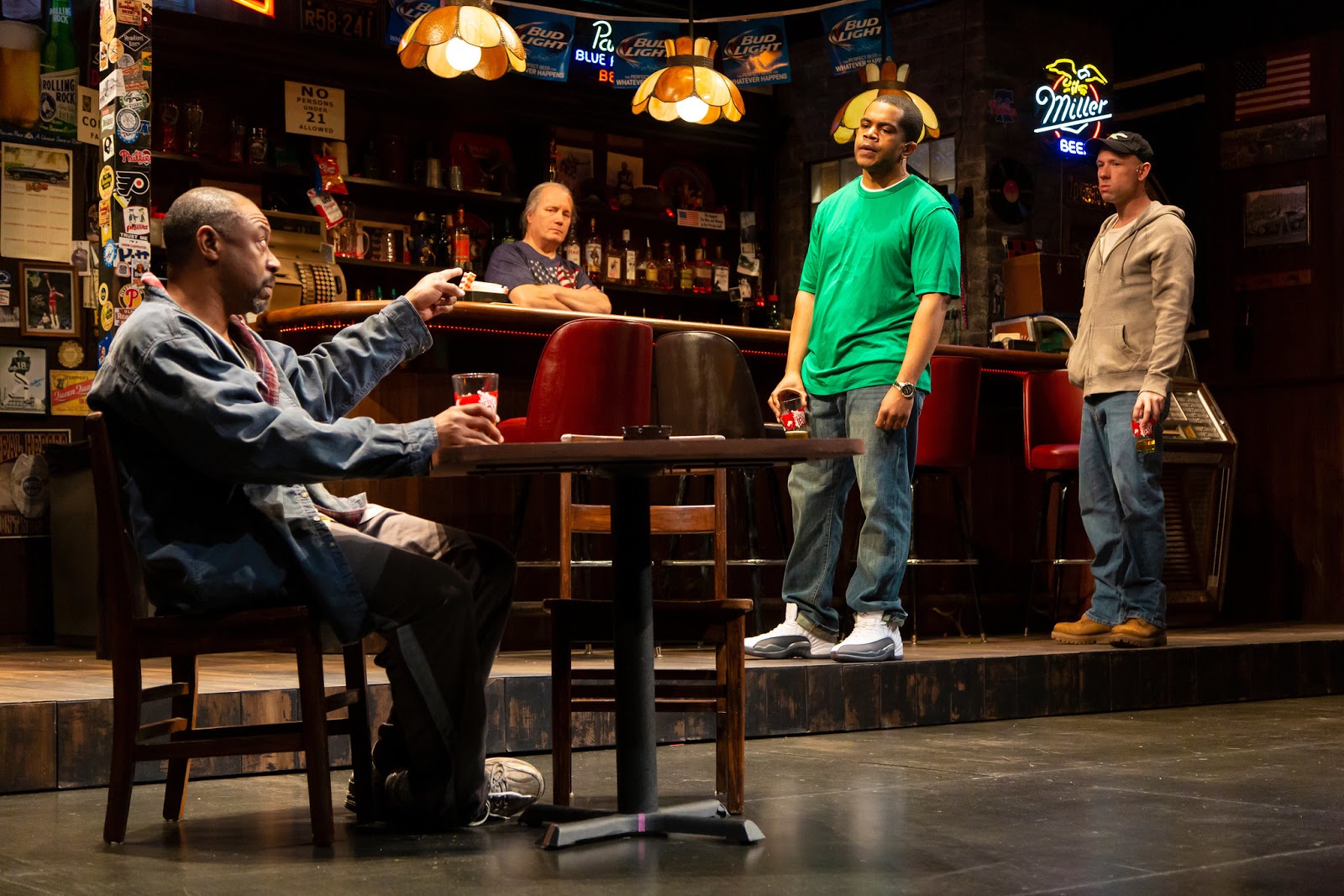
The Deindustrialization Revolution was quietly, slowly, inexorably on its way when playwright Lynn Nottage began her research for her drama Sweat, the current production mounted by Huntington Theatre Company in its Boston premiere. The play was first presented by Oregon Shakespeare Festival in 2015, then produced at Arena Stage in D.C. the same year, then Off-Broadway at New York's Public Theater, before moving to Broadway in 2017 where it was nominated for the Tony Award for Best Play and won the Pulitzer Prize for Drama. Intentionally, it's the backstory of a decade prior to the Trump election, with blue-collar types who had been largely forgotten. The playwright spent more than two years interviewing real people for her play in Reading, Pennsylvania in the nation's Rust Belt, where the poverty level was forty percent, making it one of the poorest areas of the country. This makes it of necessity the story of the economy, race relations, immigration, and inevitably, politics. But these form the foundation for society's ills; the play centers on the concrete fate of a group of workers and their way of life, those most affected by an impending crisis. It will devolve into the stark reality of community versus capitalism. As one character puts it, “that's the way things are set up”.
 |
| Marianna Bassham, Tyla Abercrumbie & Jennifer Regan in "Sweat" (photo: T. Charles Erickson) |
The story begins as parole officer Evan (Maurice Emmanuel Parent) speaks with two men (separately) set free in 2008. It goes back in time to 2000 to a bar (or more appropriately, joint) in Reading run by former steel plant worker Stan (Guy Van Swearingen) who lost his job when injured at the plant. Tracey (Jennifer Regan), whose family has worked at the Oldstead Steel Mill for generations, feels deserving of a promotion to a newly available management job offering more than just air conditioning and the metaphorical avoidance of sweat. Her son Jason (Shane Kenyon) has just been paroled, as has Chris (Brandon G. Green), son of her coworker and best friend Cynthia (Tyla Abercrumbie), who are black. The bar's regulars include the inebriated Jessie (Marianna Bassham) and Cynthia's deadbeat ex, Brucie (Alvin Keith). It also features bus boy Oscar (Tommy Rivera-Vega), a Colombian-American working for $8 an hour at the bar scraping up chewing gum, but offered a job at the mill at $11 per hour. One theme that's central to the story is how each of the three women in the work get to celebrate their birthdays, and how they all view people like Oscar to be entitled immigrants (though all of the characters, including Oscar, were born in Berks County, Pennsylvania); one of them even questions why there isn't a White History Month.
 |
| The Cast of "Sweat" (photo: T. Charles Erickson) |
“I know from experience it's shame that eats away at us”, one of them warns, and that “you could wake up tomorrow and all your jobs are in Mexico”; as another denizen of the bar puts it, there are buttons that could replace them. Most meet the dire predictions with skepticism and inertia. Even when lay-offs and down-sizing are announced, denial reigns; most can't see it coming. When the company announces plans to move the plan to Mexico, there swiftly follow trade union strikes and a lock-out. Divisions between management and labor begin to divide friends and lead to the exposing of racial tensions. Just the sort of explosion you're likely to see coming, but with a few clever twists.
 |
| Jennifer Regan & Tyla Abercumbie in "Sweat" (photo: T. Charles Erickson) |
It would be hard to imagine a better cast. Regan (who shares in the guilt to come by egging on her son) and Abercrumbie are superb foils, as are their offspring Kenyon and Green. Bassham and Keith make very natural bar flies, overseen by Van Swearingen in a fine turn. Even the more supporting work by Parent and Rivera-Vega is superior acting. Meticulously Directed by Kimberly Senior, at two and a half hours with an intermission, and a large cast, this is in many ways an old-fashioned play, in the good sense. The creative team includes detailed Scenic Design by Cameron Anderson, apt Costume Design by Junghyun Georgia Lee, excellent Lighting Design by D. M. Wood, and Sound Design and foreboding Original Music by Pornchanok Kanchanabanca, as well as the extraordinarily complex Fight Direction (really Choreography) by Ted Hewlett.
 |
| Tyla Abercrumbie & Jennifer Regan in "Sweat" (photo: T. Charles Erickson) |
As is
portrayed by the epilogue of the play, only people take care of
people, and this playwright, as she did in Ruined and
Intimate Apparel (the latter now being made into an opera)
shows once again her uncanny knack for creating realistic dialog and
believable crises. She has done her homework and it shows in this
powerful piece of writing; though hard to sit through its
relentlessly challenging chronology between scenes, it solidifies
Nottage's reputation as a playwright at the top of her game.
Unlike
the steel mill, this production has been extended through March 1st.
2/02/2020
New Rep's "Hair": Splitting
 |
| The Cast of "Hair" (photo: Andrew Brilliant/Brilliant Pictures) |
It
hardly seems possible that it was half a century ago, in 1968, that a
musical by the name of Hair
burst onto the Broadway stage, while banned in Boston. One had to
travel to New York to be able to see its brief and darkly lit nude
scene, as well as what was criticized as desecration of the flag. It
also consisted of a cast that included such future famous folk as
Diane Keaton (before she was Diane Keaton), as well as Melba Moore
and Shelley Plimpton. But its claim to fame is that it was recognized
even then as a watershed creation that ultimately led to a
proliferation of rock musicals, the precursor of works from Jesus
Christ Superstar to Rent
and even to Hamilton,
remembered for its anti-establishment themes (especially its
opposition to the Vietnam War), the draft and its hippie subculture.
It certainly wasn't (then or now) revered for its thin Book and
Lyrics by Gerome Ragni and James Rado, (both of whom were also in the
original cast) and its uneven Score by Galt Mac Dermot. The original
production lasted four years; the war it protested lasted ten. Thus
it was a surprise to see this once-famous (or infamous) show on the
calendar of the current season of productions from New Rep Theatre in
Watertown. One could only guess what this revival would be, either an
exercise in theatrical nostalgia or an updated take that would speak
to the audiences of today. Would it still evince the power to move
us, or would it be more of a trip (the other kind) down memory lane?
The answer is, both.
 |
| The Cast of "Hair" (photo: Andrew Brilliant/Brilliant Pictures) |
As this production was Directed and Choreographed by Rachel Bertone, one of the most admired of local magicians, hopes were higher than they might have been if this mounting had been assigned to less capable hands. The name and reputation of Bertone for casting her shows is also promising, with a dozen triple threat actors needed to sing and dance as well as they portray their characters. Happily this Tribe includes Sheila (Marge Dunn), Claude (Edward L. Simon), Berger (Eddie Shields), Crissy (Kris Ivy Hayes, whose character in the program is misidentified as “Ivy”), Dionne (Yewande Odetoyinbo), Jeanie (Katrina Z. Pavao), Woof (Brian-Barry Pereira), Hud (Anthony Pires, Jr.) and other unnamed members of the Tribe (Lovely Hoffman, Zoe Maloney and the charismatic Aaron Patterson); oh, and Margaret Meade (Peter Mill). Each is a gem, some more polished than others, such as the terrific Odetoyinbo, whose numerous roles in local shows have been a pleasure to encounter. The able creative team includes Scenic Design by Janie E Howland, Costume Design by Marian Bertone, Lighting Design by Franklin Meissner, Jr. and especially Sound Design by Kevin L. Alexander, all help to keep the sometimes languid pace of the plot moving.
 |
| The Cast of "Hair" (photo: Andrew Brilliant/Brilliant Pictures ) |
What
they don't do is re-envision the piece, which may be asking too much
after all this time. It comes across as a version that, even in its
most moving scenes of draft card burning, refuses to be relevant,
which is surprising given our corrupt current political
establishment. There are memorable moments among the forty or so
songs, such as “Frank Mills” sung by Hayes (but lacking the
poignancy as written) about not wanting her two dollars back from her
lover, just him. And there are many fine numbers (“Aquarius”,
“Air” “Good Morning Starshine” and “Easy to Be Hard”) as
well as many superfluous ones. (Some have been altered, thus more
politically correct, like the lyrics for “Three-Five-Zero-Zero”).
Who could deny the power of the lyrics about those who care about the
needing crowd, but not a needy friend?
 |
| The Cast of "Hair" (photo: Andrew Brilliant/Brilliant Pictures) |
On the whole this production is very well directed and performed, an altogether too safe and sanitized (were there ever such immaculate hippies, and visuals more appropriate for Godspell?) attempt at recovering that critical era in political and theatrical history that maybe can never be fully replicated. Perhaps it's best to remember the original fondly (even with its inherent flaws) as this critic does, (having seen and loved both the original Broadway and Paris versions) and enjoy the current version's performances, lest we be accused of splitting Hairs.
1/29/2020
BMOP/Odyssey Opera's Grammy Winning "Mr. Fox"
 |
| The Cast of "Fantastic Mr. Fox" (photo: BMOP) |
Tobias Picker: Fantastic Mr. Fox is the official title of the Grammy Award winning operatic compact disc release of the work by Picker, the current Artistic Director of Tulsa Opera, who pulls off the almost impossible feat of composing an opera that is aimed directly at families, not just children; that is, children of all ages. With his welcome use of melodic tonal lyricism, even though a modern piece, and the caustically witty Libretto by Donald Sturrock, this work is sure to charm listeners of any vintage. Performed by the Boston Modern Orchestra Project (BMOP) under the direction of Gil Rose, the recording features members of Odyssey Opera, the Boston Children's Chorus, and a host of well-known vocalists. Commissioned and premiered in 1998 by Los Angeles Opera, this recording was made during its performance period in Boston in 2014.
Based on the revered children's novel by Roald Dahl, the fable centers on the efforts of the eponymous fox (baritone John Brancy), the antihero who's on a food-finding mission on behalf of his family, contemporaneously thwarting the aim of three mean farmers, Boggis (bass- baritone Andrew Craig Brown), Bunce (tenor Edwin Vega) and Bean (baritone Gabriel Preisser) to kill the varmint that's been eating their chickens and geese and drinking their cider. Mr. Fox enlists his forest friends, including Mr. Porcupine (tenor Theo Lebow), Miss Hedgehog (soprano Elizabeth Futral), Rita the Rat (mezzo-soprano Tynan Davis) and others. The remaining characters include Mrs. Fox (mezzo-soprano Krista River), Agnes the Digger (countertenor Andrey Nemzer), Mavis the Tractor (soprano Gail Novak Mosites), Badger the Miner (baritone John Dooley) and Burrowing Mole (tenor Jonathan Blalock). There are also four fox cubs: Abigail Long, Abi Tenenbaum, Zoe Tekeian, and Madeleine Kline. The story is accessible as is the music (this despite the fact that Picker was trained by a trio of Modernist composers, Elliott Carter, Milton Babbitt, and Charles Wuorinen).
Picker
has stated that there can be found in this work a “green message”,
if one wishes to find one (with its portrayal of the barren land
above ground and the warmer natural world below). There are instances
of slapstick, European styles, and neoclassical Stravinsky-like
sound. In several passages, including those utilizing the Children's
Chorus, there is sublime music for adult and child listeners. In
short, it's both relatively brief and compellingly approachable in
its score with an ample supply of cleverness and wit in its libretto,
with no evidence of being “dumbed down” for its target audience.
What more could anyone want in an opera for the whole family?
And speaking of families, there's that other frequently-composed royal one, namely the Tudors, whom Odyssey Opera (and BMOP) will again revisit, this time for one performance on next Saturday February 1st at 7:30pm at Jordan Hall; it's the third of a sextet of operas they're producing this season, this one being Arnold Rosner's "The Chronicle of Nine" about Lady Jane Grey. So go on and lose your head again.
1/26/2020
Huntington's "We All Fall Down": Why is this Play Different....
 |
| The Cast of "We All Fall Down" (photo: Nile Hawver) |
We All Fall Down is Huntington Theatre Company's current production, the world premiere of a comedy by Somerville resident Lila Rose Kaplan, in her Huntington debut. It's the story of Linda (Eleanor Reissa), the matriarch of a non-observant Jewish family who suddenly decides to plan a Seder in her home in Westchester at “Passover in early April”. This comes as a surprise to the family, especially her husband Saul (Stephen Schnetzer), and the other characters, which include their two grown daughters Sammi (Liba Vaynberg) and Ariel (Dana Stern), Saul's sister Nan (Phyllis Kay), their former neighbor Beverly (Sarah Newhouse) and Linda's assistant Ester (Elle Borders). As Kaplan notes in the program, it started as a play about a daughter, evolving into a play about a whole family, in keeping with the playwright's body of theatrical works that emphasize women's stories and family intergenerational relationships. As she puts it, “we are so many ages inside. To put more than one age on stage and the page is really a more true portrait of what it is to be a human.” Director Melia Bensussen adds that the Haggadah, a text that tells you all the steps in a Seder, tells the story of Moses from birth to exodus, in the process becoming a theatrical experience that Kaplan describes as the original dinner theater. At a spare ninety minutes or so, it's fast if not furious, and soon answers the query as to why this play is different from other plays. Because it is.
 |
| The Cast of "We All Fall Down" (photo: Nile Hawver) |
It's a
curious amalgam of Borscht belt comedy (for example, having Beverly,
who is not Jewish, refer to Passover as the “Jewish Easter”) and
underlying family tragedy. There is a longing for the beliefs that
once brought people together. First-timers to a Seder are advised to
bring with them a measure of patience, and no bread (or anything with
leavening, no yeast or beer). It comes to pass that we realize that
there's a place for everyone here, as we celebrate liberation: while
we were once slaves, we are now free. Playwright Kaplan admits that
the fact that her first name, Lila, means “night” in Hebrew, led
her to explore why this night is different from all other nights, and
to reflect on the reason people from Jewish culture are drawn to
Seder, namely the same reason we are all drawn to theater: we come
together for storytelling, which helps us to become better at being
human. This concept comes vividly true toward the end of the play
when it somewhat suddenly shifts to seriousness even as the family
re-enacts the old familiar nursery rhyme from childhood:
Ring
around the rosy, a pocket full of posies, ash, ash, we all fall down.
The
meaning of the song has long been lost to the ages, but the use of it
in this pivotal scene exposes what one already has surmised if she or
he has been paying attention to the clues the playwright has dropped
along the way.
 |
| The Cast of "We All Fall Down" (photo: Neil Hawver) |

Lurking
beneath the sporadic hilarity of the play, as in most comedies, is a
serious look at the ever-expanding reality that many folks of
previous faith have lost the spiritual aspects of their daily
existence, exhibited in the wry expression “I don't believe in God,
but I miss Him”; or, as Pogo long ago put it in his comic strip
philosophical musings, “God isn't dead, He's just unemployed”.
1/20/2020
speakeasy's "pass over": but also.....
 |
| dapping up: hubens "bobby" cius & kadahj bennett in "pass over" (photo: nile scott studio) |
pass
over, a new play by antoinette
nwandu, is the current co-production by speakeasy stage company and
the front porch arts collective. after first being performed by
chicago's steppenwolf, it was then produced in new york at lincoln
center, where it won the lortel award for best play (and was filmed
for amazon by none other than spike lee).
described
as a “mash-up” of waiting for godot (considered
by some as a theatrical masterpiece and by others as like watching
paint dry) and the exodus story. at a spare ninety minutes, directed
by monica white ndounou, it's written all in lower case, reminiscent
of the poetry of e.e.cummings, performed as though it were blank
verse or rap without music. the setting is “now, right now, but
also 1855, but also the thirteenth century b.c.e”. the time is “a
ghetto street, a lamppost, night, but also a plantation, but also
egypt, a city built by slaves”.
 |
| ossifer enters: lewis d. wheeler, hubens "bobby" cius & kadahj bennett in "pass over" (photo: nile scott studios) |
its
cast is spare as well. one is a young black man named moses (kadahj
bennett) “but also a slave driver, but also the prophesied leader
of god's chosen people”; a second young black man is named kitch
(hubens “bobby” cius) “but also a slave but also one of god's
chosen”; the remaining two roles, both played by lewis d. wheeler,
are mister, a seemingly wholesome chap given to expressions like
“gosh golly gee”, “but also a plantation owner but also the
pharoah's son” and ossifer, an officer of the law (or “po-op”),
“but also a patroller but also a soldier in the pharoah's army”.
as in the becket play, the two lead characters are unable to leave
their street corner. there is no intermission; if moses and kitch
cannot leave neither can we.
 |
| mister's picnic: lewis d. wheeler, kadahj bennett & hubens "bobby" cius in "pass over" (photo: nile scott studios) |
there
are some obvious parallels to becket even in a brief synopsis of the
work, but it stands on its own as an absorbing and alarming expose of
contemporary black experience. kitch declares that the name “moses”
portends that he will lead “deez boys right off deez streets on to
dat promised land”. moses himself alludes to a land of milk and
honey despite lactose intolerance and glycemic indexes, as these are
the least of their troubles, truly nothing compared to the
obliviousness of “mister” who cannot grasp why they get to use
the “n-word” but he does not; he is clueless about his not having
the right to use the word. (yet, interestingly, the playwright feels
free to portray moses' use of the charged term “faggot”). moses
disses those who are fixated on passing over to the promised land of
heaven, where he proclaims he wants that good life now. it's telling
that both young men can recall every name of those who have been
killed in their hood, giving the lie to the presumption that these
victims (including one of the most oppressed societal groupings, that
of trans people of color) are ordinary, even forgettable. in ancient
pyramidal times, in the not-so-ancient plantation era, and on the
inescapable street corner, once again history repeats itself, or at
least rhymes.
 |
| promised land: hubens "bobby" cius & kadahj bennett in "pass over" (photo: nile scott studios) |
attention must be paid not just to the triumph of the playwright's words on the page but also in its execution by director ndounou and her three stellar actors, each of whom seems to be thoroughly immersed in his character. the simple but effective contributions of the creative team include scenic design by baron e. pugh, costume design by chelsea kerl, lighting design by kathy a. perkins, and sound design by anna drummond.
 |
| promised land 2: hubens "bobby" cius & kadahj bennett in "pass over" (photo: nile scott studios) |
as the
playwright herself puts it, an audience won't be immediately
transformed or relieved of her or his baggage, but find such baggage
“a little bit shifted”. the most memorable aspect of her play, as
opposed to becket's, is that her characters aren't left alone, to
age. just as the frequent use of the “n-word” can never be
completely erased, and in fact has become for the community of color
an expression of brotherhood (and sisterhood), so audience members
may find this sometimes enigmatic work either an affirmation or a
revelation.
what
they won't feel is that it is forgettable, (extended through
february 2nd), but also.....
1/12/2020
Lyric's "Cake": More than a Mere Trifle?
 |
| Karen MacDonald, Chelsea Diehl & Kris Sidberry in "Cake" (photo: Mark S. Howard) |

 |
| Karen MacDonald in "Cake" (photo: Mark S. Howard) |
 |
| Fred Sullivan, Jr. & Karen MacDonald in "Cake" (photo: Mark S. Howard) |
That omission is the very real issue of discrimination, which is treated comically, glossing over the ugly underbelly of this ninety-minute one act treatment. It's a tribute to MacDonald's prowess as an actor that she manages to present her character in a believable way; the same could be said for the remainder of the cast, with Diehl's earnest portrayal alongside Sidberry's overt LGBTQ militancy and Sullivan's hilarious spouse with his heterosexual intimacy hangups. It's of some interest that the creative team includes an Intimacy Director (Ted Hewlett) in addition to the expert Direction by Courtney O'Connor (currently the Acting Artistic Director of the company). Despite the histrionic talent on display, the play has some half-baked elements, but this production is fortunate to have several estimable creative contributions, from the Scenic Design by Matt Whiton, to the Costume Design by Charles Schoonmaker, Lighting Design by Aja Jackson and Original Music and Sound Design by Arshan Gailus. They're all supportive of the play's heart, with MacDonald as the frosting.
 |
| Kris Sidberry & Karen MacDonald in "Cake" (photo: Mark S. Howard) |
There
are some clever elements to the story (references to Noah's Ark and
the dinosaurs, Chick Fil-A and the like) and a few hysterically
memorable moments. This being a comedy, the end is rather baked in,
so to speak, and its intentions, though often predictable, are
admirable. On the whole, this production is well done.
As
Della ultimately proclaims, “you need cake”, until February 9th.
1/04/2020
BSO's "Beethoven/Tchaikovsky": Two Fifths
 |
| Marcelo Lehninger conducting the BSO (photo: Hilary Scott) |
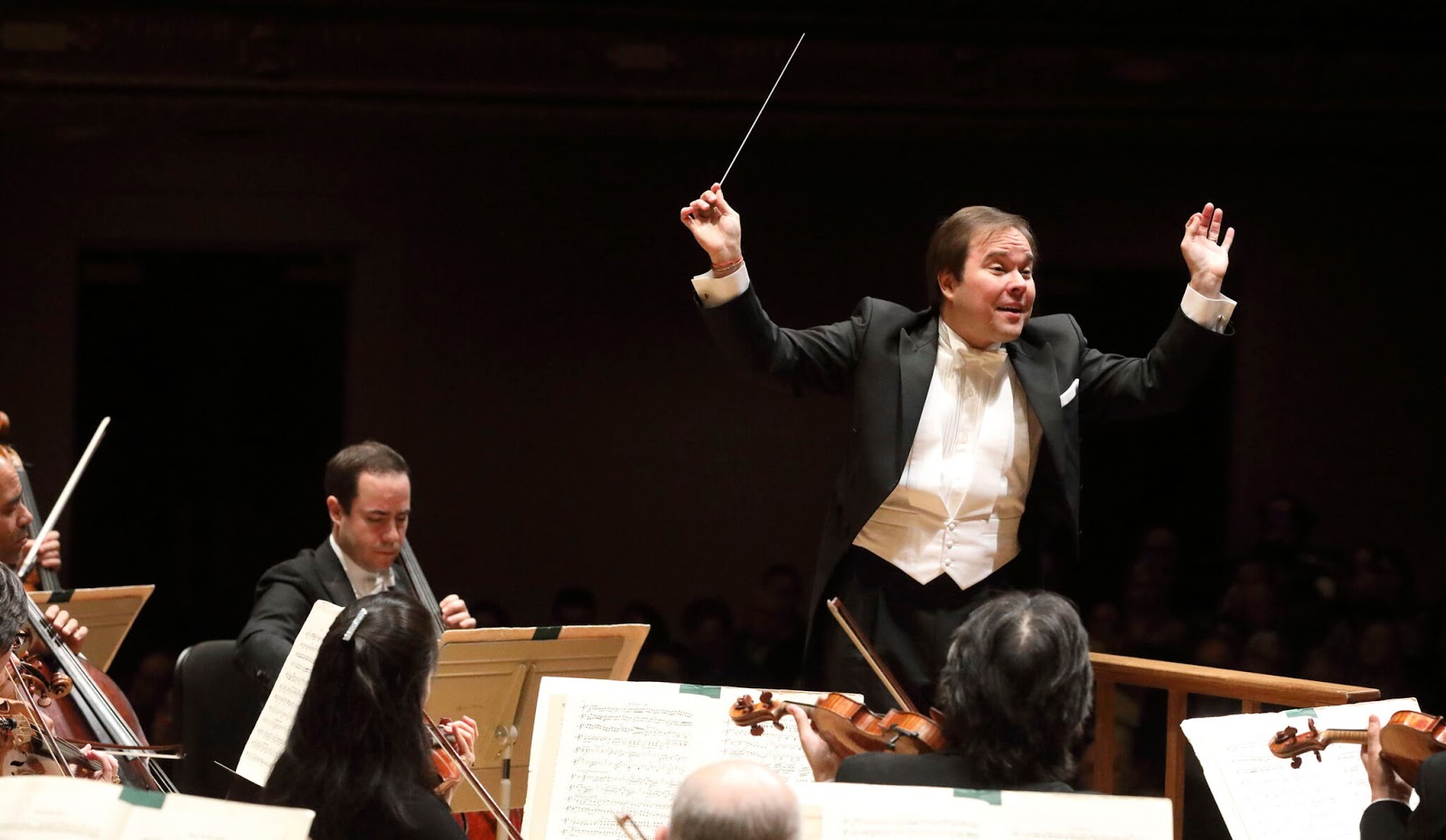
Beethoven's
Overture to the Creatures of Prometheus, Opus 43 made for a
fine if relatively slight curtain raiser (only five minutes in
length) for the Boston Symphony's latest program. First performed in
Vienna in 1801, it was introduced to Tanglewood audiences in 1958
(and again, most recently, in 2014). It was for the youthful composer
his first mature score for theatrical use, namely to support a
ballet. The brevity of the piece about the fable of Prometheus and
two statues brought to life makes for an uncharacteristic
comparatively light composition for Beethoven, but served to set the
mood for this BSO concert, under the baton of Marcelo Lehninger,
former BSO Assistant Conductor, who last led the BSO in 2014.
There
followed a performance of Beethoven's Piano Concerto No.5 in
E-Flat, Opus 73, a substantially more impressive work (clocking
in at forty-two minutes), featuring Pianist Javier Perianes, who last
played with the BSO in 2016. Aptly described in the program notes as
“heaven-storming”, it was Beethoven's final concerto, first heard
in 1811, as part of what is generally acknowledged as the “heroic
period”. Its initial BSO performance was in 1911 and at Tanglewood
in 1947. It was seen by the composer himself as a real affirmation while in
the midst of “terrible times” (Austria being engaged in one of
several consecutive wars with France). Known in English-speaking
countries as the “Emperor” (for reasons that are totally unclear)
it is a deservedly beloved work that includes amongst its movements
the longest he ever wrote. The audience at the matinee performance
was nothing short of ecstatic for Lehninger, Perianes (who earned his
encore) and the orchestra itself.
 |
| Maestro Marcelo Lehninger & Pianist Javier Perianes with the BSO (photo: Hilary Scott) |
The second half of the program consisted of Tchaikovsky's Symphony No.5 in E Minor Opus 64, another rousing piece at forty-seven minutes with its powerful lyrical theme of the Fates that unites all four of its movements. His Fourth had been his symphony of triumph over fate, an imitation of Beethoven’s Fifth. As noted in this concert's program, for Tchaikovsky’s own Fifth Symphony, we have an outlining for the scenario for the first movement: “Introduction. Complete resignation before Fate, or, which is the same, before the inscrutable predestination of Providence. Allegro. Murmurs of doubt, complaints, reproaches against XXX. Shall I throw myself in the embraces of faith? A wonderful program, if only it can be carried out.” The composer's reference to “XXX” is generally considered most likely an allusion to his homosexuality, which terrified him as a possible cause of scandal; others attribute this to his gambling addiction. Though he detested it when writers interpreted his musical processes too literally, the theme with which the clarinets (beautifully played and justly singled out for applause), in their lowest register, begin the symphony has a function other than its musical one: it reappears as a catastrophic interruption of the second movement’s love song, with the languid dance of the waltz, and in its majestic E major triumph. Tchaikovsky’s terrific gift of melody is shown in his delight in what he calls “strong effects” and his skill at bringing them off, with quite remarkable effect yet with great economy. After his return from a journey to Prague (where the experience of conducting the Fifth produced the most depression in him) he quickly began work on The Sleeping Beauty, and not long after that, his finest operatic score, The Queen of Spades. But once again Lehninger (conducting this time from memory) proved the Fifth Symphony itself worthy of the almost hysterical climaxes it provides. Both central movements were delights in quite different ways, and the audience for both gave enthusiastic approval. It was the Boston Symphony Orchestra at its finest.
12/13/2019
Moonbox's "Parade": Uncivil Wars
 |
| Phil Tayler & Anna Bortnick in "Parade" (photo: Sharman Altshuler) |
 |
| The Cast of "Parade" (photo: Sharman Altshuler) |
The musical's story begins as a Confederate soldier goes off to fight the Civil War, and segues to 1913 when the disabled veteran readies himself to march in the annual Confederate Memorial Day parade held dear by Southerners who refused to commemorate their loss in the war. The (true) story takes place at the trial of a Brooklyn-born Jewish factory manager in Atlanta, Leo Frank (Phil Tayler, reason enough to see any show), accused of raping and murdering his thirteen-year-old employee Mary (Anna Bortnick), daughter of Mrs. Phagan (Anne Sablich). She had previously flirted with Frankie Epps (Gable Kinsman), who falsely testified that she complained to him about the looks Frank would give her. Thanks to this lie (corroborated by a trio of young girls who knew her, played by Lilli Jacobs, Katie Elinoff and Angela Syrett) and a rabid press, including right-wing journalist Tom Watson (Todd Yard) and ambitious novice newsman Britt Craig (Dan Prior), as well as politician Hugh Dorsey (Jerry Bisantz) who resolves to solve the case, and an equally rabid crowd.
 |
| Aaron Patterson & The Cast of "Parade" (photo: Sharman Altshuler) |
With testimony from worker Jim Conley (Aaron Patterson), Frank was convicted and sentenced to death by Judge Roan (Brad Peloquin). When this death sentence was commuted, a mob emerged to attempt to take justice into their own hands. One eerie note: librettist Uhry's great-uncle in real life owned the factory managed by Frank. Also featured in the cast of characters as witnesses are Minnie McKnight (Yewande Odetoyinbo) and Newt Lee (Elbert Joseph), as well as Luther Rossner (Andrew Child). Everyone in this production, beginning with Tayler and his wife Lucille's (Haley K. Clay) slowly percolating roles and extending to some show-stealing turns by Prior and Patterson, was stellar.
 |
| Dan Prior & Gable Kinsman in "Parade" (photo: Sharman Altshuler) |
The later 1915 parade passes by as the ensemble reprises “The Old Red Hills of Home” and the score ends with this as well. There are more than two dozen songs in all, making this work virtually operatic, with standouts such as “Pretty Music”, “Do It Alone”, Leo's poignant “It's Hard to Speak My Heart”, Conley's jaunty “That's What He Said”, the jury's chilling cakewalk “Closing Statement and Verdict” and “All the Wasted Time”, Frank and Lucille's near-finale duet; this song expressly deals with how both have grown through their impending tragedy and their captivating relationship, after Lucille castigated him for his intention to work on a holiday. Their feelings morph from cold to warm as Lucille begins to fight for her husband's freedom and his life. Throughout the play, Brown displays obvious homages to the Great American Songbook, from Sousa to Sondheim, a mesmerizing score sung by a meticulously elegant cast.
 |
| Phil Tayler & Haley K. Clay in "Parade" (photo: Sharman Altshuler) |
Wonderfully
Directed by Jason Modica, the production boasts almost non-stop,
exquisite Choreography by Kira Troilo, impeccable Music Direction by
Catherine Stornetta, fabulously imagined Set Design by Lindsay
Genevieve Fuori, terrific Costume Design by Chelsea Kerl, essential
Lighting Design by Steve Shack and ominous Sound Design by Elizabeth
Cahill. On the performance and creative levels, there's not a nit to
pick. This is as close to perfection as regional theater (or any
theater) gets, fundamentally due to Modica and Tayler, whose
dedication to the work goes back a decade to their Boston
Conservatory efforts. It may be a less hopeful entity these days, but
remains a haunting work, and an obvious labor of love.
It
should be noted that both the revival of the KKK (Klu Klux Klan) and
the rise of the ADL (Anti-Defamation League) resulted from this
historical event. 'Nuff said.
Before
this Parade passes by, be sure to take it in, through December
28th.
12/12/2019
ART's "Moby-Dick": Call Me a Schlemiel
 |
| Manik Choksi & The Cast of "Moby Dick" (photo: Evgenia Eliseeva) |
Call one whatever, but who knew? Moby-Dick? Harpooned, yes, but hyphenated too? As it turns out, yes and no; it depends on which edition one's referring to, back when Herman Melville first published his iconic 1851 novel of rage, revenge and reverence, with hyphen in one published version, without it in another. Neither was a success, for the balance of his lifetime, but it would eventually be held up as an integral addition to American literature (in fact declared the greatest American novel ever written by none other than Nathaniel Philbrick). In more recent times, the work has been the source for countless film and operatic versions, and now, at American Repertory Theatre in Cambridge, it's in the creative hands of the folks who brought you Natasha, Pierre and the Great Comet of 1812. With that provenance one would expect this, with Music, Lyrics, Book and Orchestrations by Dave Malloy, Developed with and Directed by Rachel Chavkin, to be a revelation.
 |
| The Cast of "Moby Dick" (photo: Evgenia Eliseeva) |
As it turns out, again, yes and no. If broadly written, acted and directed slapstick is your thing, then half of this show would be right up your alley. If not, then it must be said that the good (or bad) ship Pequod is barely afloat, in fact adrift, revealing neither focus nor purpose. Given the source material in the novel, with its vast cornucopia of symbols, themes and metaphors, subtlety surely would be called for, but is sorely lacking in this production. The complexities are there beneath the surface, from the pure whiteness of the titular animal with its forces (nature, God, fate) beyond man's control vs. free will, to the inevitability of evil amid moral ambiguity. You'll find the original author's themes of duty, defiance, doubt and death, along with obsession, the limits of knowledge and the pervasive underbelly of race. It also preserves the narrator's quest, his spiritual journey to discover his own sense of self. A few decades ago, this critic enrolled in a Harvard course on Religion and Literature given by Amos Wilder (brother of Thornton), whose emphasis on this very novel was revelatory. This mashup of theatrically bizarre elements reveals only how even the most renowned creative folks can go so horribly off course. After three and a half hours of sophomoric mayhem one almost ends up cheering on the whale. Not that there isn't a lot of talent on display; it's just diluted by overlong segments involving an anachronistic stand-up comic routine that's well done but overdone, a seemingly endless boat ride that involves audience participation straight out of a ride at Disneyland, and an extended showstopper (in a bad sense) of a deviation dealing with Pip that also seems to go on forever (because it does).
 |
| The Cast of "Moby Dick" (photo: Evgenia Eliseeva) |
On the plus side, there's a good deal of memorable music in varying styles from jazz to gospel to folk/country to Broadway (and even echoes of whales clicking), all performed by an inexhaustibly energetic cast consisting of Ishmael (Manik Choksi), Queequeg (Andrew Cristi), Starbuck (Starr Busby), Blacksmith/Sailor 1 (Ashkon Davaran), Flask (Anna Ishida), Tashtego (Matt Kizer), Daggoo (J. D. Mollison), Ahab (Tom Nelis), Pip (Morgan Siobhan Green), Stubb (Kalyn West), Fedallah (Eric Berryman), Carpenter/Sailor 2 (Kim Blanck) and Father Mapple/Captains of the Albatross, the Bachelor & the Rachel (Dawn L. Troupe). Standouts include Troupe, Nelis and Choksi, but there's not a clinker in the bunch. As for the rest of the creative team, the complex Musical Direction and Supervision was by Or Matias, with lively Choreography by Chanel Da Silva, overwhelmingly enveloping Scenic Design by Mimi Lien (with reflections of Quaker meeting houses, and a life of violent and broken obsession), eclectic but apt Costume Design by Brenda Abbandandolo, extraordinary Lighting Design by Bradley King, equally important Sound Design by Hidenori Nakajo and clever Puppet Direction by Eric F. Avery. One is tempted to repeat one's own recent reference in another review: Squid pro quo; fortunately, one resisted this temptation.
 |
| Andrew Cristi & The Cast of "Moby Dick" (photo: Evgenia Eliseeva) |
Would
that the powers behind this theatrical quest had resisted the obvious
lure of including material from 40 of the 135 chapters in the book
(by comparison, their Natasha, Pierre and the Great Comet of 1812
was based on 70 pages from War and Peace). There are some
captivating choices (clarifying the homoerotic feelings of the
narrator toward his “cannibalistic” bedmate, for example; or the
songs about etymology, cetology and squeezing sperm; or frequent
pulverizing of the fourth wall), and about half of the show would
make a very promising piece of theater. As it now stands, it's
correctly described by Chavkin as “epic messiness”. What this
work cries out for is not a harpoon but scissors; it's such a mash-up
of three and a half hours of random set pieces and performance art
that it threatens to destroy all the good aspects of blubberhood.
Succinctly, the show's playbill cover subtitle says it all: “a
musical reckoning”; if you have the patience and stamina to await
its best moments, there is a lot of wheat amongst the chaff.
Meanwhile,
we are all in the belly of the whale, at least until January 12th.
Subscribe to:
Posts (Atom)