11/06/2017

Lyric's "Souvenir": A Legend in Her Own Mind

Leigh Barrett & Will McGarrahan in "Souvenir"
(photo: Mark S. Howard)

Barrett. McGarrahan. Veloudos. That's about all you need to know about the current revival of the play all three of these artists previously presented at Lyric Stage Company about a decade ago: namely Souvenir, a Fantasia on the Life of Florence Foster Jenkins, by Stephen Temperley. If you saw it then (or off-Broadway in 2004, or on Broadway in 2005, or in the movie about the same real-life person just this past year), you owe it to yourself to see how all three of these artists now recreate their hilarious depiction of one of history's most memorable performers. As helmed by Spiro Veloudos, Producing Artistic Director of the company for the last twenty years, there are brought back to life treasured memories, by the entire cast. They would be Leigh Barrett in the title role of aspiring classical concert diva and Will McGarrahan as her accompanist Cosme McMoon. And you're probably laughing already at that improbable duo. As Veloudos notes in the program, in music the term “fantasia” implies improvisation, and this play does precisely that. If you've never encountered these uniquely ungifted characters (played by uniquely gifted actors) before, one must admit to feelings of envy, as there's nothing like coming across this twosome for the first time.

Unless it's the second time. Which is inexplicably even better. Perhaps it's the shock of plain recognition that, yes, they were and are that absurdly enthralling. Maybe it's the most earth-shaking fact that actors, even if they seem perfectly cast, can on second viewing seem recast as amazingly new, fresh and improved. When we first encounter McMoon (oh, that name just makes one swoon) at a Greenwich Village supper club in 1964, we can immediately grasp the depth and density of their commitment. The crowning moment (or nadir) of the public life of this wealthy socialite who sold out Carnegie Hall is at one and the same time a howling success and a career-breaking end. It's a simple demonstrable fact, as evidenced by Jenkins' actual recording of her performance of, among other pieces, the Queen of the Night's solo aria from Mozart's Magic Flute. Friends of this critic who possessed a copy shared it (and may never be spoken to in polite circles again).


Will McGarrahan & Leigh Barrett in "Souvenir"
(photo: Mark S. Howard)

How an actor can present a fully grounded character who is totally believable yet impossibly bizarre is a wonder. Barrett has proven her comedic and singing chops before (most recently in the Lyric's version of Gypsy), but this time out she's ready to surprise us again with a drive that entertains relentlessly while subtly revealing how intricate and complex Jenkins was as a celebrity, long before social networking and the internet cloud; she reigned on a cloud of her own in which her audience, then and now, is sublimely complicit in her blissful unawareness. And let's not overlook the reactive contribution of the steadily, increasingly incomprehension on the face of McGarrahan as he accompanies both her and us on this journey (he is also the program's Music Director). They're a perfect match made in auditory heaven (or hell). Either way you see and hear it, it's cause for rejoicing. Never before has such bad been so good.

Creative accompanists include Scenic Designer Skip Curtiss (repeating his terrific work on the 2007 version), Lighting Designer Chris Hudacs and Sound Designer David Wilson, but most especially, Costume Designer Gail Astrid Buckley, whose work on this piece alone should evince belly laughs. But the utmost praise is due to that triple threat of Barrett, McGarrahan and Veloudos, responsible for an uncanny cascade of mind-boggling side-splitters, rib-ticklers and knee-slappers galore. Your attitude toward musical performance may never be quite the same after you've experienced this souvenir of a bygone era. (Or error).

It's become a cliché to praise a piece of comic theater these days as being an escape from the madness of the current White House, but it's true; you couldn't ask for a more entertaining cure (for two hours at least) of madcap mayhem, on offer until November 19th. By all means, go!

10/28/2017

SpeakEasy's "Curious Incident": It All Adds Up

Craig Mathers & Eliott Purcell in "Curious Incident of the Dog in the Nightime"
(photo: Nile Hawver/Nile Scott Shots)

As its title suggests, the play The Curious Incident of the Dog in the Night Time promises to be an unusual experience. What piques our curiosity is not just the strangeness of the title but the equally strange journey it suggests. Based on the popular 2003 novel by Mark Haddon, adapted by Simon Stephens, the play's West End premiere took place in 2012. Subsequently brought to Broadway in 2014, it became the longest running Broadway play in the past decade, winning five Tony Awards including Best Play. It was no wonder that sound, lighting and set design all won 2013 Olivier Awards in London, and lighting and scenic design for the 2015 Tony Awards. These technical aspects are crucial to the mathematically intricate light and sound cues of the play. In the present production by SpeakEasy Stage Company, the Scenic Design is by Christopher and Justin Swader, and the Lighting Design is by Jeff Adelberg, with Sound Design by David Remedios and Costume Design by Gail Astrid Buckley. Each deserves special up-front mention given the sheer complexity of light and sound cues, and visuals. But technical achievements aside, what most distinguishes this theatrical treat is its amazingly involving storytelling, translated and transformed from page to stage by Stephens. But, as they say about restaurants with dazzling design, you can't eat the décor.

What you can take in and digest is the convoluted yet totally absorbing tale of a fifteen year old (presumably with autism) who discovers the titular canine done in by a pitchfork and proceeds on a quest to solve the murder in true Holmes-ian fashion, appropriate since the title of the book and play reference a quote by the great fictional detective himself from Conan Doyle's short story Silver Blaze. But this is not a mystery in the deductive sense. What matters in the end is not the solution but the process of reasoning, primarily by Christopher John Francis Boone (Eliott Purcell), and those with whom he intersects along the way, from his teacher Siobhan (Jackie Davis) to his father Ed (Craig Mathers) to a crucial discovery at the termination of his quest, involving his mother Judy (Laura Latreille). The play also conveys a sense of humor, as when Christopher remarks that “the word 'metaphor' is a metaphor”, “acting is like lying”, or when the obvious is stated by his father: “we're not exactly low maintenance, are we?”. The amazing reality for anyone familiar with the novel is how Stephens managed to adapt the source given its multi-level form. It stands as a major theatrical accomplishment.


Laura Latreille & Eliott Purcell in "Curious Incident of the Dog in the Nightime"
(photo: Nile Hawver/Nile Scott Shots)

It should come as no surprise that Purcell (from the SpeakEasy mounting of Hand to God) is excellent in the central and crucial lead. He's fascinating to watch in a very challenging role, always completely in character. It's a star-making performance, and he nails it. The rest of the cast are all superbly chosen, from Mather to Latreille to Davis, well-supported by the small ensemble each enacting multiple roles: Christine Power, Tim Hackney, Cheryl McMahon, Damon Singletary, Alejandro Simoes and Gigi Watson. Under the precise direction by the company's Producing Artistic Director Paul Daigneault, with essential Movement Direction by Yo-El Cassell, this production may well be the best this company has ever presented, and that's saying quite a bit. By the end of the play you really believe you can answer Christopher when he asks: "Does that mean I can do anything?".   And attention must be paid to the critical work by Dialect Coach Amelia Broome.

There is little one can describe that wouldn't negatively affect the unanticipated but real joy of discovery of the play's revelations, even for those familiar with the source novel. Nothing one has heard about its visual and auditory splendors could possibly prepare a theatergoer for the overall impact of this work. It's most appreciated at a venue this size (the National Tour was seen at a nearby theater with some three thousand seats, a travesty). It cries out for a more intimate experience such as this one. If you think you've already seen this piece, think again. You owe it to yourself to see this up-close-and-personal version. Ultimately this is a mathematically ingenious piece that succeeds in presenting a multi-faceted, time-warping, mind-boggling, ultimately satisfying resolution. You simply can't quantify the value of leaving the theater with a huge smile on your face, especially in these worrisome times for our country. The level of astonishment is, well, immeasurable.

All for a piece that features the versatility of math. Go figure. As Christopher himself would no doubt put it: Q.E.D.


10/27/2017

Odyssey Opera's "Siege of Calais": Well-Done Burghers

The Cast of "Siege of Calais"
(photo: Kathy Wittman)

The opera Siege of Calais or L'assedio di Calais, by Donizetti, premiered in Naples in 1836, and word has it that the composer didn't care much for his own work, never arranging for revivals. Despite the popularity of his other bel canto operas, this one is still very rarely heard (though the Glimmerglass Festival featured it this past summer in its U.S. premiere). We have Gil Rose and his Odyssey Opera to thank for enabling Boston audiences to appreciate a long-neglected work. With a libretto by Salvatore Cammarano (performed here in Italian with English titles), based on the play of the same name by Luigi Marchionni, this is a fully-staged production at Huntington Theatre. It serves as a welcome element in the current five-opera season of operas dealing with Joan of Arc (though technically, this opera is a wee bit of a stretch, as it doesn't feature the French saint but does concern Edward III's year-long siege of Calais during the Hundred Years' War). It also partially answers the question as to why this particular Donizetti work has been by and large ignored. Both musically and dramatically, it's an undeniably inert piece, notable mostly for its unfamiliarity. For most of the opera there's not much to appreciate, though in the hands of superb choral singing (as is the case here) it makes the case for presenting this minor work by a major composer more frequently than once or twice every millennium.


The Cast of "Siege of Calais"
(photo: Kathy Wittman)

The year is 1346 and the forces under Edoardo III, King of England (John Allen Nelson) and his general Edmundo (Sumner Thompson) are laying siege to the city of Calais The heroic central figure Aurelio (Magda Gartner, in a trouser role, unusual for Donizetti, who typically limited such pants roles to supporting ones such as Orsini in Lucrezia Borgia or Smeton in Anna Bolena), is the son of the mayor, Eustachio (James Westman). His family starving, Aurelio attempts to breach the siege to steal supplies, but is seen, though he eludes capture. Eustachio and Aurelio's wife Eleanora (Lucia Cesaroni) assume he has died, but the burgher Giovanni d'Aire (Neal Ferreira) brings news of Aurelio's safety. When Aurelio returns, he asks his father if there is any hope, and gets a silent response. A group of citizens led by a stranger (Luke Scott) arrives to demand Eustachio's death and surrender to the enemy, but Eustachio unmasks him as an English spy, rallying the people to face death with courage and honor. Later, as Aurelio sleeps, Eleanora prays for the salvation of the city. Aurelio awakes from a nightmare in which he was about to be killed as he watched the murder of his infant son. Suddenly Giovanni brings news that terms of peace have arrived from the enemy namely that a pardon will be issued for the citizens if six prominent members volunteer to be executed. At first all are horrified, but Eustachio proclaims he will sign first. Aurelio offers to go in his stead, but is refused. The four burghers Giovanni, Giacomo de Wisants (Alan Schneider), Pietro de Wisants (James Demler) and Armando (Christopher Carbin) all sign. Aurelio again volunteers and this time he is accepted into the group of martyrs who lead a hymn to the country, joined by the citizens for whom they prepare to die. But all ends happily thanks to the intervention of Isabella, Queen Of England (Deborah Selig). Fans of Deus ex machina will be pleased.

This performance, Conducted by Gil Rose, with Stage Direction by Joshua Major, was often wonderful to hear. The singing by Cesaroni, Gartner and Westman was superlative. The creative team included Chorusmaster Mariah Wilson, Scenic Designer Dan Daly, and Lighting Designer Dennis Parichy. All had a hand in reviving this brief (just over two hours) work.

Don't let another few centuries fly by; if you missed this performance, October 28th at 7:30pm is your second and final chance to catch all these well-done burghers.


10/26/2017

Goodspeed's "Rags": Making American Immigrants Great Again

Samantha Massell & Christian Matthew Camporin in "Rags"
(photo: Diane Sobolewski)


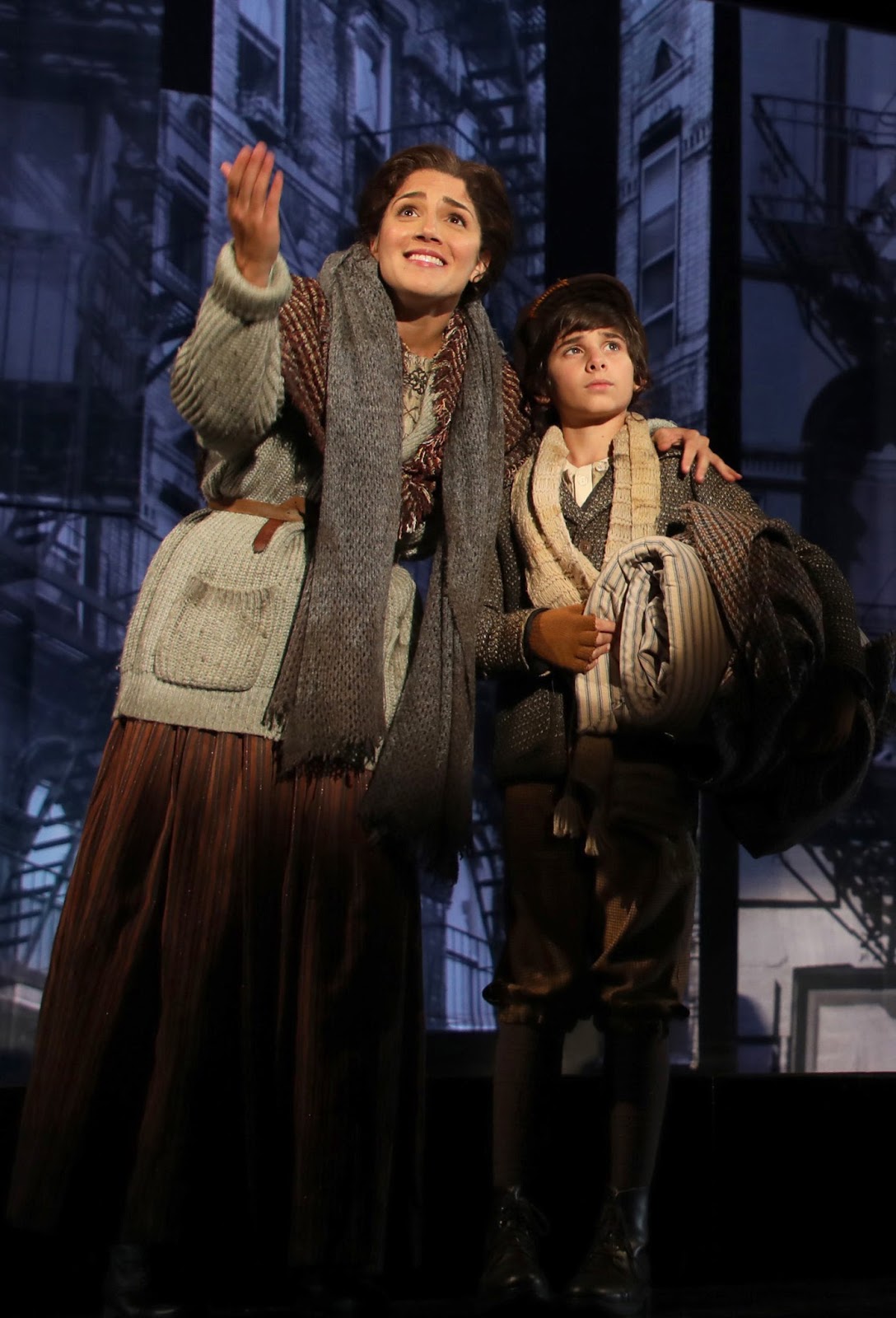
The first thing that hits you as the revival of the 1986 musical Rags begins on the Goodspeed Musicals stage is how timely and eerily appropriate it is. In 1910, a hopeful group of immigrants looks for their future in this promising new world, as David Thompson who wrote the new Book for the show notes, and each must decide “what's to be gained and what's to be lost” in this world. Those who are courageous enough to face cultural assimilation head on, and who possess such qualities as “cheek”, are most likely to succeed, but nothing is guaranteed given the name-calling of the sort of Greek chorus (the “quintet”), labeling the new arrivals as “greenhorns”, and much worse. This is what might have happened to Tevye and his five daughters after the curtain fell on Fiddler on the Roof. Who would have anticipated that the trials and tribulations that are echoed today (and yesterday and tomorrow) for immigrants would be even more insidious and relentlessly fascistic than ever before? This revival has heart and sentiment but is rooted in harsh reality.

Looking back at a 1986 program from the pre-Broadway Boston tryout of the musical Rags, one is struck by an odd fact, namely that no one is given credit as the show's director; as it happens, there was a series of directorial changes over the run of the tryout. In his memoir Put on a Happy Face, Charles Strouse, who wrote the score for the show (with Lyricist Stephen Schwartz) describes a rather unique creative process that included his being punched by its star, opera diva Teresa Stratas who allegedly also threw a chair at him. She missed many performances during the Boston tryout, including a thrice-postponed opening night “related to bronchitis”. At the New York premiere it lasted only four performances, yet got five Tony Award nominations, including Best Musical. Having seen the show and its star during the Boston run, and one revival (in 2003 at Boston Conservatory Theater) this critic can also say it surely deserved better. The story is of the early 1900's Eastern European immigrants to America, fleeing prejudice, fear and cynicism, only to be met by the same in their new country; as Strouse asks, “remind you of today?”. He goes on in the memoir to enumerate the show's many musical influences: “music was bubbling in the streets, in brothels, in barrooms and at Bar Mitzvahs; Irish clog dancing met black rhythms and suddenly tap dancing was there.” While it centers on the tale of an immigrant woman's “loves, traditions and indestructibility”, for him, the story is its music. One might infer from the fact that the current production boasts an update of the original, and disappointing, Book by Joseph Stein (who was much more successful with his work in Fiddler on the Roof), here, as revised by Thompson, the libretto has finally had the attention it needed.

At the beginning of the show, a group of people arrive in America on the same boat: Rebecca Hershkowitz (Samantha Massell), a widow escaping from a village pogrom with her son David (Christian Michael Camporin), and Avram Cohen (Adam Heller) who temporarily houses them, Bella his teenage daughter (Sara Kapner) and Ben Levitowitz (Nathan Salstone), a real find, a youth in love with Bella. All find jobs: Rebecca as a dressmaker for the rich Max Bronfman (David Harris); Bella with piecework at home; Ben in a factory; and Avram and David peddling from a pushcart. Rebecca meets Sal Russo (Sean MacLaughlin),a labor organizer trying to unionize, and starts to fall for him. Meanwhile widow Rachel Brodsky (Lori Wilner) grows to love Avram. Tragedy leads to the radicalization of Rebecca. A strike leaves Rebecca, David, Avram and Ben to make new lives for themselves as another shipload of immigrants arrives. As they say, assimilation is everyone who moves in after you do.


The Cast of "Rags"
(photo: Diane Sobolewski)

The Quintet (J. D. Daw, Ellie Fishman, Danny Lindgren, Sarah Solie and Jeff Williams) noted above provides a threatening view of society's underbelly, and each sings superbly the score, with some new numbers (about the same number of songs as those that were written out of the show). Strouse and Schwartz (also responsible for Wicked and a little show called Annie that had its world premiere at Goodspeed) are still at the top of their game, with their score that includes memorable songs such as Children of the Wind, Blame It on the Summer Night, Brand New World, and the first act closer, Rags.

This production was Directed by Rob Ruggiero, with Choreography by Parker Esse, Scenic Design by Michael Schweikardt, Costume Design by Linda Cho, Lighting Design by John Lasiter, Projection Design by Luke Cantarella, Sound Design by Jay Hilton, and Musical Direction by Michael O'Flaherty. It's a bit of a Fiddler on the Roof Goodspeed reunion, with the same director, choreographer, scenic and lighting designers, and both former leads, Tevye (Heller) and Golde (Wilner). One could also include the same musical director, but that would be cheating, as O'Flaherty has served in that role here at Goodspeed for twenty-six seasons.

Rags is in terrific shape, having trimmed the number of players and focused on the humanity presented by this amazing cast. Massell is a wondrous find both as singer and actor, MacLaughlin is a suitably hunky lead, Camporin is a delight, and even the heavy, Harris, has a fabulous tenor voice. All are firmly and solidly directed by Ruggiero, and perhaps just need to lessen the few overly sentimental moments especially in the second act. As it stands, this new and improved version, with even stronger and more profoundly Jewish storytelling, is a winner.

See it again for the first time, through December 10th.

10/19/2017

Huntington's "A Guide for the Homesick": What Happened?

Samuel H. Levine & McKinley Belcher III in "Guide for the Homesick"
(photo: T. Charles Erickson)

It was a dark and stormy night. So begins A Guide for the Homesick, the current Huntington Theatre Company production, a new play by Huntington Playwrighting Fellow Ken Urban, a fast-paced (and frequently too much so) 75 minute intermission-less two-hander. It was commissioned by New York's Epic Theater Ensemble (which advocates for social justice) as a play about international aid workers.  Urban, via interviews with Doctors Without Borders, discovered what problems they encountered upon coming home and facing the reality of life's readjustments. In January 2011, a young aid worker, returning from a six-month stint in Uganda, visits a shabby hotel room in Amsterdam rented by a fellow American.  The two strangers seek redemption from their pasts and confess to one another their (shared) fear that they may have betrayed the very people who had needed them most, and how each is haunted by the people they met.  Their initially passionate encounter becomes an opportunity to deal with the truth for both Teddy (McKinley Belcher III, seen at Huntington in Smart People and Invisible Man) and Jeremy (Samuel H. Levine, in his Huntington debut). In the case of Teddy, he has a tendency to fall in love with the wrong person. In the case of Jeremy, he questions: "How did I get here?".  And both could rightly ask: "What Happened?".
 
So could the audience. While providing some of his familiar effective devices such as very natural overlapping of dialogue (an approach put to better use in the playwright's earlier work A Future Perfect  three years ago at SpeakEasy Stage Company), in this outing Urban seems to have overlooked the need for a blueprint of sorts for those encountering this play for the first time. We do learn that Teddy, from Roxbury, is visiting Amsterdam with his best friend Ed, about to be married, while Jeremy's recent personal history echoes the real-life hysteria that surrounded Uganda's Anti-Homosexuality Bill and the long tradition of US medical intervention. We at first wonder “what happened” to Jeremy's friend Nicholas (also played by Belcher) and where Ed (also portrayed by Levine) is. In the play's non-linear form, we gradually begin to see what each man Teddy and Jeremy are running from. The room becomes a haven for each from his past; as the program notes explain, a “small sanctuary of a hotel room (and what is more haunted than that)...escape from chaos (that) offers the possibility of a different future.” They grapple with ethical issues, one's responsibilities, and the meaning of friendship; they aren't heroes or philanthropists, but basically selfish, or at least self-centered. The play here at least hints at the seeming dichotomy that people can do good while fulfilling their own need to be needed. There are some truths unearthed, such as when Teddy states that it's always “easier to believe that things will get better”, or the ranting of Ed about a “whale's frequency so high that no other whales can hear” (recognizing that no one understands his cry for help). Toward the end of the play, Teddy tells Jeremy: “it's not too late. To change. To face the truth.”

It's also not too late to rescue this work from its present hyperventilated state. As it winds up, with dizzying speed, it becomes more difficult to follow who's who in the present or past (despite the helpful but increasingly frenetic use of lighting by Russell H. Champa to delineate where we are and when). A major part of the problem was the fateful (and, alas, fatal) choice to have the two actors each play the roles of the other's antagonist, a decision that doesn't make it any easier for an audience to follow time and location changes at warp speed. Perhaps the author wanted to convey the similarities that could be found in each of these characters, but it makes for a confusing ride during which we don't learn enough about any of them while at the same time attempting to follow what actually does happen. The acting helps, as both players are intense and obviously committed to the piece, though the characters of Teddy and Nicholas are fleshed out more than that of Jeremy and Ed, giving Belcher more room to expand his roles than Levine's less defined ones.

Both Teddy and Jeremy are from from Boston, and this is no coincidental choice by the playwright, given the contradictory facts of the role of our Commonwealth in LGBT rights, and the interference in the politics of Uganda by certain far right religious Massachusetts bigots. The stark reality of anti-homosexual fervor has been portrayed in recent works as disparate as Witness Uganda and even The Book of Mormon. The creative team, as always with Huntington, is expertly involved, from the (appropriately tacky) Scenic Design by William Boles to the realistic Costume Design by Kara Harmon and ominous Sound Design and Original Music by Lindsay Jones, to the rapid-fire Direction by Colman Domingo.

Philosopher Jacques Derrida is quoted in the program notes: “To have a friend is to know that one of the two of you will inevitably see the other die. (This is) the mourning that we expect from the very beginning.” The playwright has hit upon a universal theme that surely merits attention, but here requires more clarification; as it stands it's a work in progress rather than fully satisfying theater.

This latest effort by Urban, testament to his developing career, is on view until November 4th at the Calderwood Pavilion at the Boston Center for the Arts. As a presentation of homophobic hysteria, in its current unfocused form, the play is a noble but only partially realized effort.


10/17/2017

New Rep's "Oleanna": Rashomon Test

Obehi Janice &  Johnny Lee Davenport in "Oleanna"
(photo: Andrew Brilliant/Brilliant Pictures)

David Mamet's plays can be very frustrating when he continually fails to finish his-
It can be exhausting having to fill in the-
It's sort of like seeing a Pinter play without the British-
And the staccato delivery his prose requires can be monotonous when-
So one has to keep up with the sporadic dialog that-

Oleanna by David Mamet was both product and precursor of its time, and probably should be seen and heard in that context. Yet the issues the play raised then remain unresolved today and continue to effect the way we employ survival techniques in our current society. Both Hollywood and Washington provide modern templates for a contemporary revisit to the work's gender and power battlegrounds. At New Rep in Watertown, Director Elaine Vaan Hogue attempts to do just that. A clue to what's going to transpire is in Mamet's choice of title, from a satirical song made popular by Pete Seeger, based on the failed concept of a utopian society (Oleanna being one of four proposed towns) in Pennsylvania envisioned by a Norwegian violinist.

Any appearance by Obehi Janice, or Johnny Lee Davenport, automatically qualifies as worthy theater; an appearance by these two fine actors on the same stage makes for must-see theater, no matter the play. The fact that the play is one by Mamet written around the time of actual events such as the Anita Hill/Clarence Thomas two-hander provides still more reason to attend this tale, given the current political state of affairs. While the play itself was written twenty-five years ago, sexual politics are unfortunately still alive and unwell in our society, so a revisit to this work should prove enlightening at the very least.


Obehi Janice & Johnny Lee Davenport in "Oleanna"
(photo: Andrew Brilliant/Brilliant Pictures)

The underbelly of the play, as is typically true with Mamet, is power. It may seem to be about the politically correct and the perception of reality from differing points of view, but make no mistake about it, the professor John (Davenport) and his student Carol (Janice) experience more than a mere misunderstanding or polarized inherent views of misogyny or feminism. With the incisiveness that one also has come to expect from Mamet, this time comes a reversal of those pivotal viewpoints, in one act heavy-loaded in one direction, in another the stark opposite, reminiscent of the film Rashomon or the song Someone in a Tree from Sondheim's musical Pacific Overtures. Is this bias or selective memory?

Mamet as usual provides little or no exposition; he has gone on record as concerned with the question of “What does the protagonist want...that's what drama is...what gives rise to the drama, what is the precipitating event, and how at the end of the play do we see that event culminated. Do we see the protagonist's wishes fulfilled or absolutely frustrated? That's the structure of drama”. There are other playwrights who share these concepts, but most of them provide a blueprint. Mamet, here and elsewhere, offers an opportunity for actors to shine, and both these actors do. Under Vaan Hogue's keen direction, Davenport excels in the less showy role, while Janice once again proves her astonishing range and depth. Aiding them are the Scenic Design by James F. Rotondo III (clever in its suggestion of a boxing ring), while the Costume Design by AJ Jones mirrors the actors' changing roles, and the precise Lighting Design by Bridget K. Doyle and Sound Design by Arshan Gailus are equally contributive.
 
You may share their verbal bouts through November 5th, but one might do well to move with haste, as before one knows it, the run of the show will be-


10/16/2017

Fathom Events' Met Opera "Magic Flute": Who But Masons?

The Metropolitan Opera's "The Magic Flute"
(photo: Met Opera)

The Magic Flute by Mozart is known for its use of imagery and symbolism from Masonry, which influenced the visual approach taken by the masterful Julie Taymor, who not only created the Production but was also responsible for the Costume Design and (with Michael Curry) Puppet Design. Taymor's work is already a beloved staple at the Met that grounds the opera in the mysticism of its Masonic sources and clarifies an otherwise potentially confusing plot.

In a mythical land Prince Tamino (Charles Castronovo) and bird catcher Papageno (Marcus Werba) are sent by the Queen of the Night (Kathryn Lewek) to rescue her daughter Pamina (Golda Schultz) who is being held captive by Sarastro (Rene Pape) and his brotherhood of priests. Tamino falls in love with Pamina's picture and plans to win her. At the Temple of Sarastro they learn that it's actually the Queen who is evil, and Sarastro, realizing Tamino and Pamina are meant for each other, promises Pamina eventual freedom. Tamino first undergoes the trials of initiation into the brotherhood. Pamina is horrified when the Queen asks her to kill Sarastro, who tells her he doesn't seek vengeace. Meanwhile, Tamino and Papageno are forbidden to speak, which makes Pamina heartbroken when she thinks Tamino doesn't care. Papageno meets an old lady who flirts with him, and he considers suicide when he can't find a (young) girl for himself. Tamino and Pamina are reunited after many trials, and Papageno discovers the old lady is really a young girl named Papagena (Ashley Emerson) with whom he falls in love (they'll save a fortune on the monogrammed towels). Finally the Queen and her entourage storm the temple but are driven away. All hail the triumph of courage, virtue and wisdom.


Marcus Werba as Papageno in "The Magic Flute"
(photo: Met Opera)

As beautifully Conducted by James Levine, with simple Choreography by Mark Dendy, stunningly magical Set Design by George Tsypin, and brilliant Lighting Design by Donald Holder, it remains a visual treat, enhanced by the HD Direction by Gary Halvorson and the presence of HD Host Nadine Sierra. But it was the singing that truly immersed viewers, from Castronova and Schultz as the young lovers, Werba and Emerson as the comic duo, and the seasoned work of Pape and Lewek. It was a joy to listen to Lewek's aria especially, known as a challenging audience pleaser.

Thankfully this is not the highly truncated kiddies' version in awful English translation that the Met offers for holiday audiences, but a full (almost four hour) and fully satisfying journey.
 
 
Encore performance will be HD broadcast on Wednesday Oct. 18th at a theater near you.